
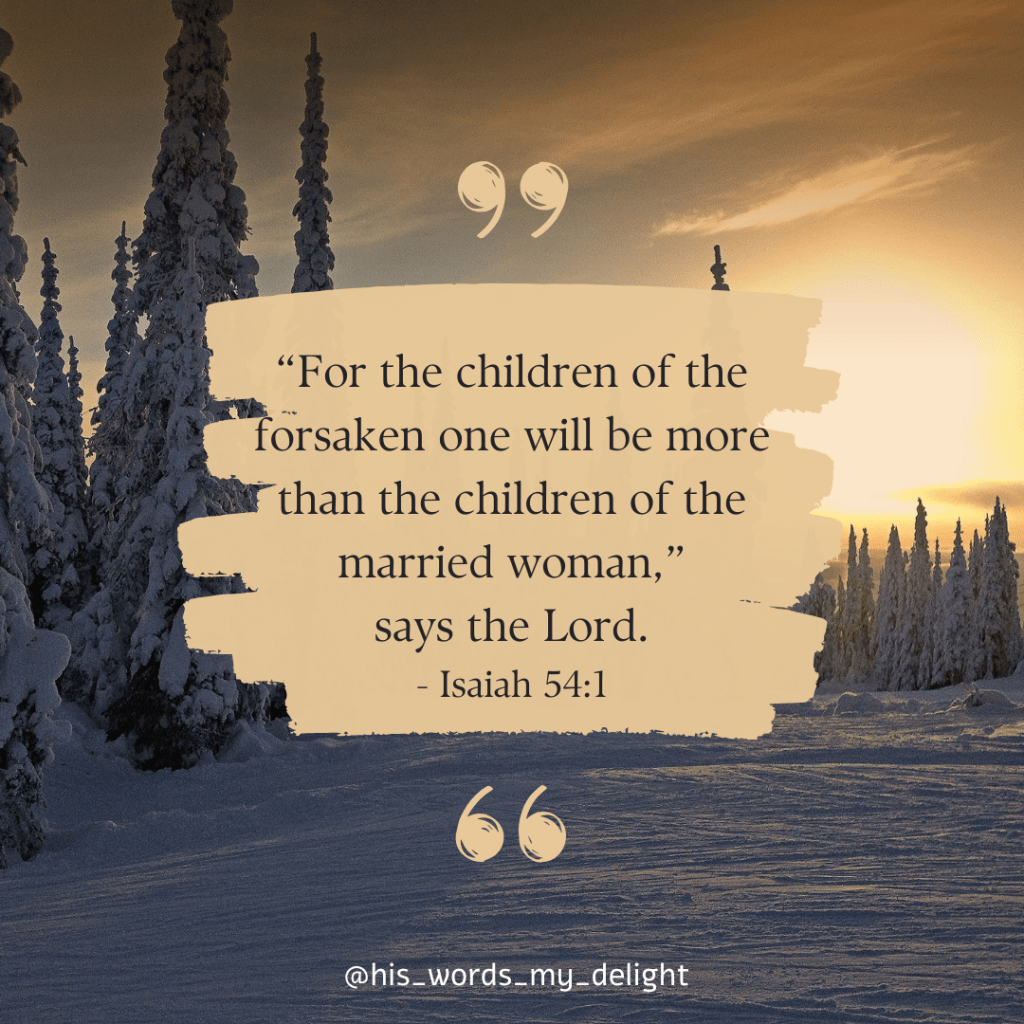
“Rejoice, childless one, who did not give birth;
burst into song and shout,
you who have not been in labor!
For the children of the forsaken one will be more
than the children of the married woman,”
says the Lord.
In this passage from Isaiah, I love how God doesn’t tell the woman longing for children, “It’s fine, you don’t need children to live a fulfilled life.” He promises her what she aches for – and more than she would have had if she’d borne children the way she wanted.
“Enlarge the site of your tent,
and let your tent curtains be stretched out;
do not hold back;
lengthen your ropes,
and drive your pegs deep.
For you will spread out to the right and the left,
and your descendants will dispossess nations
and inhabit the desolate cities.”
He encourages her to prepare in advance. To act as though his promise has already come true before there’s any sign of it. Make room! Your home will be overflowing! Get ready!
“Do not be afraid, for you will not be put to shame;
don’t be humiliated, for you will not be disgraced.
For you will forget the shame of your youth,
and you will no longer remember
the disgrace of your widowhood.”
I think it’s hard for us to comprehend the shame barrenness brought to women in Bible times and cultures. We see it discussed, but our society functions so differently. It’s not even a social norm to long for children. If I mention that I want kids, people mostly laugh in a, “Sure you do, that’s cute,” sort of way. But God does not shy away from acknowledging the grief and humiliation that accompanied this. He doesn’t tell this woman her shame did not exist, but he assures her it will change.
“Indeed, your husband is your Maker-
His name is Yahweh of Hosts-
and the Holy One of Israel is your Redeemer;
He is called the God of all the earth.
For the Lord has called you,
like a wife deserted and wounded in spirit,
a wife of one’s youth when she is rejected,”
says your God.
We could take these verses as a promise that every woman who wants children will have them, or stretch it further and take it as a promise that anyone who wants anything will receive it. But our fallen world doesn’t work that way. An understanding of the whole picture of scripture shows clearly that God does not make such promises for this life.
So what do we have here?
A picture of a Redeemer.
This passage immediately follows the more familiar Isaiah 53, with its “Suffering Servant” prophecy of Jesus’ sacrificial death. Jesus who came to redeem. What does that redemption look like?
It looks like a barren woman, deserted by the husband of her youth, hurting, lonely, humiliated, disgraced, grieving, wounded in spirit.
And now she receives a new husband. Her Maker. The God of all the earth. He’s going to provide extravagantly. He will heal her barrenness, so well she needs to start making her home bigger now to prepare for all the children she will have. She will rejoice and sing and be so happy and peaceful that her previous shame will no longer even come to mind.
God redeems grief. He redeems fruitlessness. He redeems wounds caused by others. He redeems physical brokenness. He redeems shame and humiliation and fear and disgrace and wounded spirits. And he redeems with far more goodness than there’d have been if it all went right in the first place.
Whatever sin and grief your life holds right now, you can turn to God and hope in his lavish redemption.
Praise God!
(Isaiah 54:1-6)
*



 His Words, My Delight.
Leave a comment